Skip to content

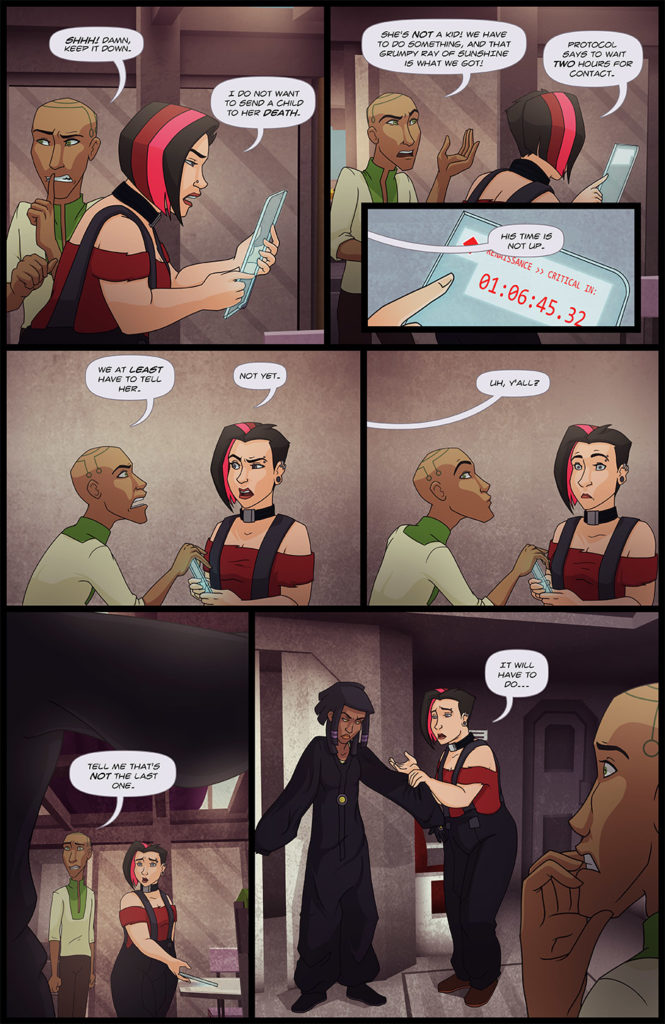
Pg. 20: Eyes in the Sky

Pg. 20: Eyes in the Sky published on No Comments on Pg. 20: Eyes in the Sky

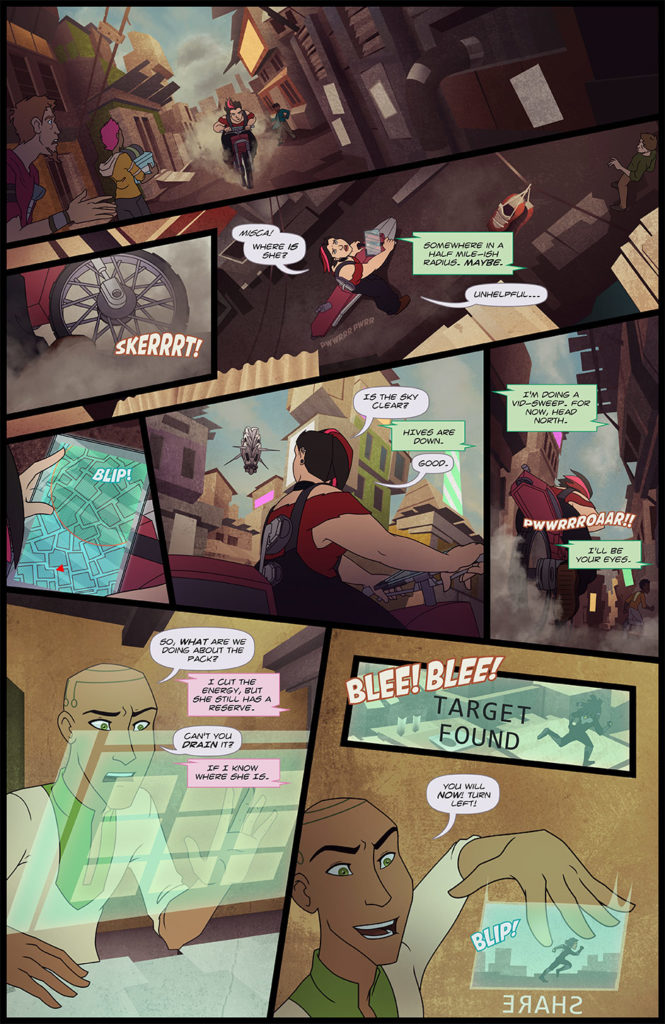
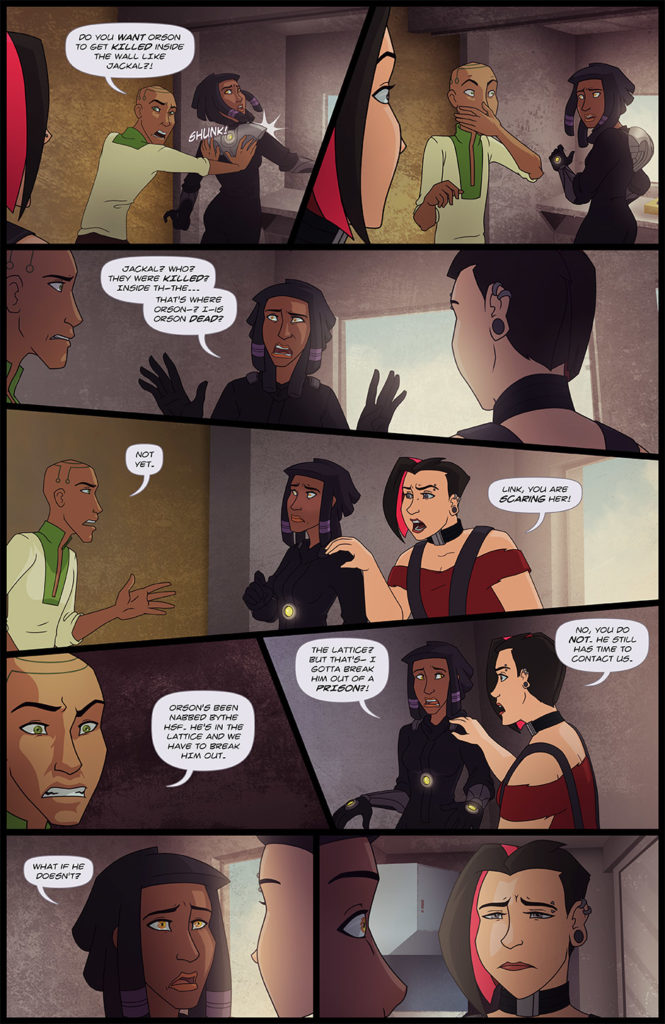
Audrey and Link scramble to find their AWOL agent!

Without getting too bogged down in the technical details, the Pack has a unique power system. Energy is always flowing into the device. This is a double edged sword. On one hand it means the user has a technological advantage. But if the energy overflows the Pack becomes volatile and prone to damage that would be irreversible in the field. Orson has hounded Audrey to provide simple solutions to the damaged-in-the-field problem. This request has clashed hard against a promise he made when she joined his team: No one will ever know the inner-workings of this specific technology, including him. In the years they’ve worked together Orson and Link are no closer to understanding exactly how the Pack works now, than they were on day one. Link thinks her taciturn response to Pack specific questions are because Audrey’s too lazy to explain it in English. Orson’s theory is much darker.

Support the comic! Become a Patron, buy from our Store, or vote for free!
Pg. 18: Unconvinced

Pg. 18: Unconvinced published on No Comments on Pg. 18: Unconvinced

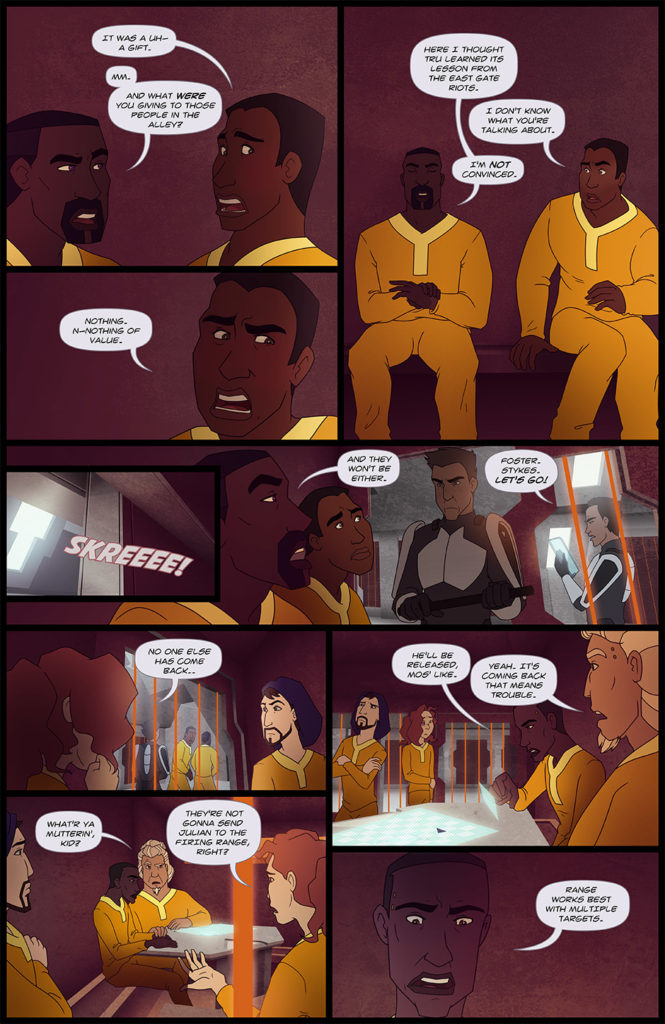
Julian dodges Orson’s questions, but they’re interrupted by HSF guards. The other inmates worry for Julian’s fate.

Support the comic! Become a Patron, buy from our Store, or vote for free!
Public executions were common during the wild and rough early history of Trinity, but have since fallen out of favor. Now, executions are only shown during special circumstances and broadcast to the public. The favored method of execution by the HSF is through firing range. Multiple prisoners are brought to the top of the wall. They’re lined up on the edge of the wall with ropes tied around the ankles and anchored in place. When shot the executed fall backward they’re left to hang from the edge of the wall for a few days. While public executions have fallen out of favor, the hanging bodies are usually so small most people don’t notice them.

Pg. 17: Turnabout

Pg. 17: Turnabout published on No Comments on Pg. 17: Turnabout

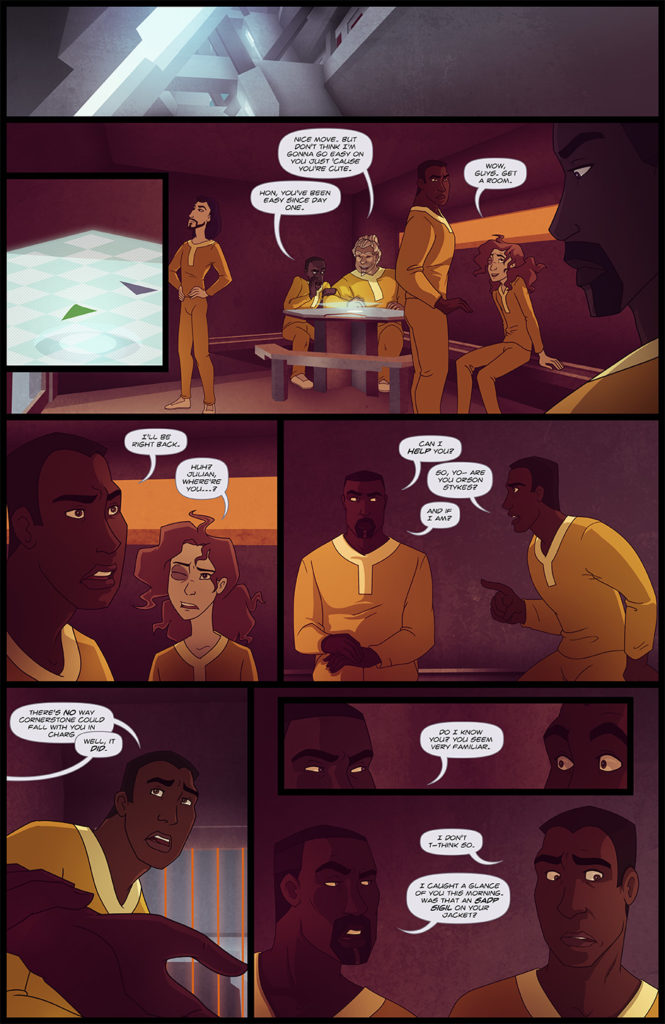
Julian wants to get some answers, but Orson turns into the one asking questions.

Support the comic! Become a Patron, buy from our Store, or vote for free!
The SADP sigil is a bastardization of an Old World flag from South America. It depicts a white crescent representing the moon over a blue field representing the earth. Popular thought in the SADP is that the moon is a guardian of the earth. Therefore, they see themselves as protectors of their lands, and seek to find, preserve and guard all manner of flora and fauna. The flip side of this is that the SADP has a well earned reputation of theft. Other city-states rarely welcome SADP humanitarian aid due to fear of some part of their plant or seed stores turning up missing.

Pg. 16: Hard Pass

Pg. 16: Hard Pass published on No Comments on Pg. 16: Hard Pass

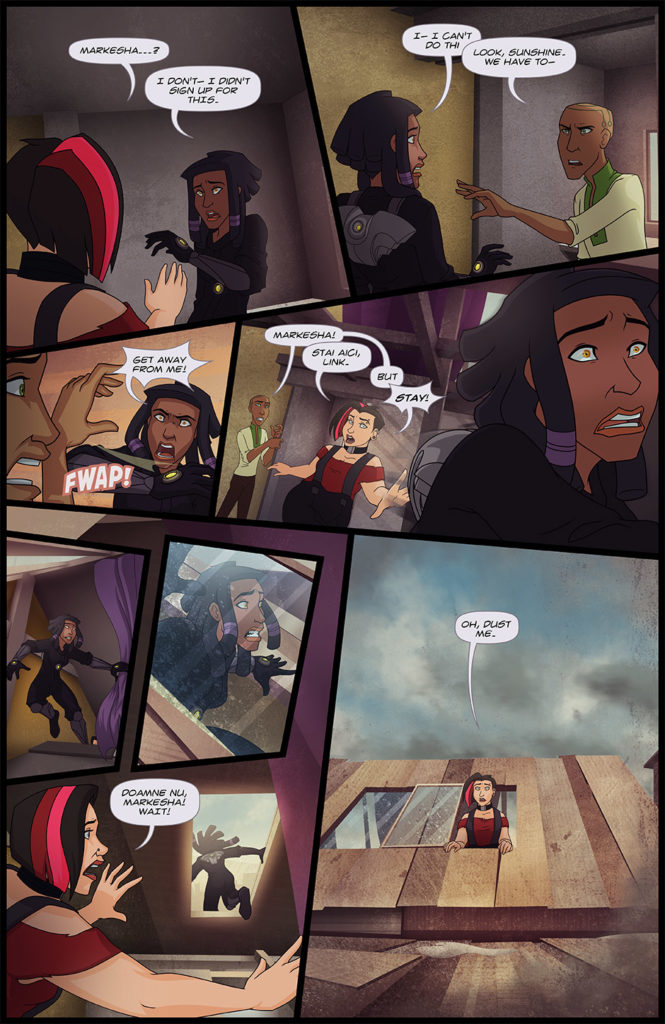
It’s never a good day when you lose the new hire and your secret tech in broad daylight.

Support the comic! Become a Patron, buy from our Store, or vote for free!
The rooftop access to the Nin apartment was added by Markesha’s mother, Cassie. The latch and hinge system was installed for quicker access to the clotheslines on the rooftop. Over the years this windows function has served less as a path to getting laundry done and more as a convenient escape hatch for Markesha. It’s gotten to the point that Toshi doesn’t really expect Markesha to use the front door anymore.

Pg. 15: Locked In

Pg. 15: Locked In published on No Comments on Pg. 15: Locked In

Link’s let the cat out of the bag about Orson’s situation and Markesha is suddenly feeling very locked in.

Orson’s onboarding process for a new agent usually begins with a one-on-one conversation in a quiet location. This talk includes topics such as payment plan, security procedure, safeguards, and mission objectives.  If and when the recruit agrees, only then does the work of outfitting and training the new agent begin. Should the recruit refuse the job Orson takes swift measures to insure his projects continued secrecy.

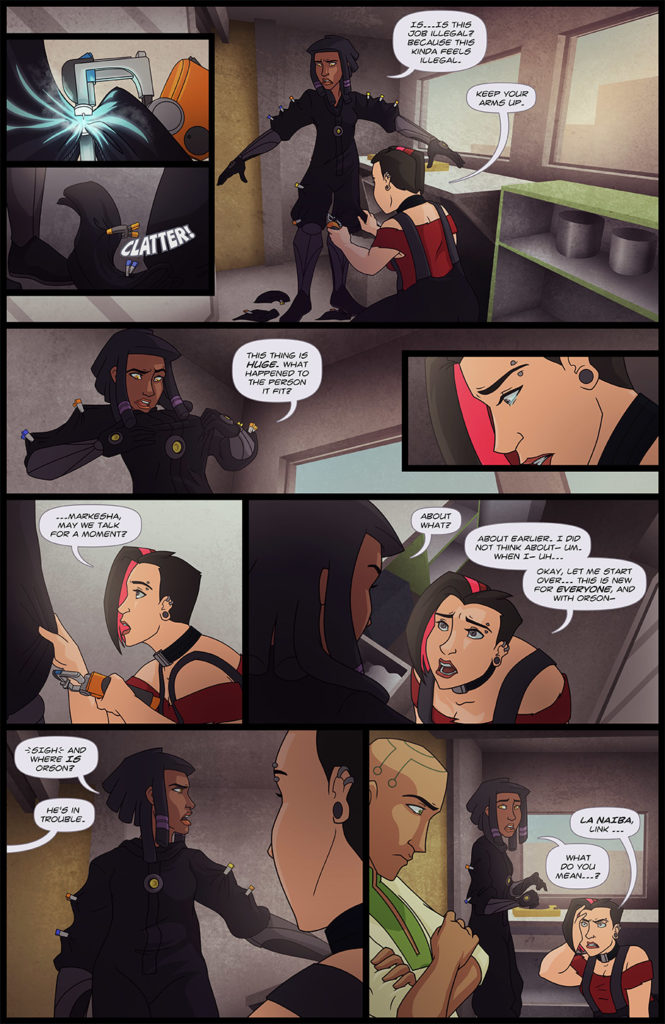
Pg. 14: Hard Packed

Pg. 14: Hard Packed published on No Comments on Pg. 14: Hard Packed

Arguments and introducing exotic technology to skittish rookies are always a great combination.


Due to the C-Amp Silk material the suit is made of tailoring cannot be accomplished through the usual scissor, needle and thread affair. The best way to modify a suit like the one Markesha’s wearing is to use heat. Tailoring has had to be done in the past, so Audrey gathered an industrial laser cutter, large calipers, an adjustable wrench and a questionable power source to create the perfect tailoring tool. The cutter emits a bright hot beam of energy that simultaneously cuts and cauterizes the fabric closed. Thankfully the material of the suit dissipates the heat well enough that residual burns aren’t a problem.

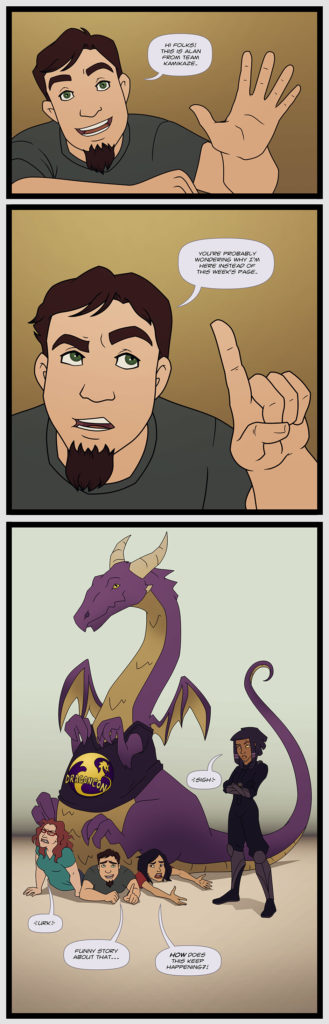
Dragon, Dragon, Rock the Dragon!

Dragon, Dragon, Rock the Dragon! published on No Comments on Dragon, Dragon, Rock the Dragon!

This week the team pauses it’s normal posting due to a sudden onslaught of Dragons~!

We’re gearing up for a weekend of working the largest convention in the Southeast US, DragonCon! Our own Alan is a featured guest this year, and will be speaking on multiple panels about creating comics, character design and more. Character Artist Havana will be joining us through the con, as well as our editor Dee. If you’re headed to the convention you’ll find us in the Comic and Pop Artists Alley at table 412! We’ll be back soon!

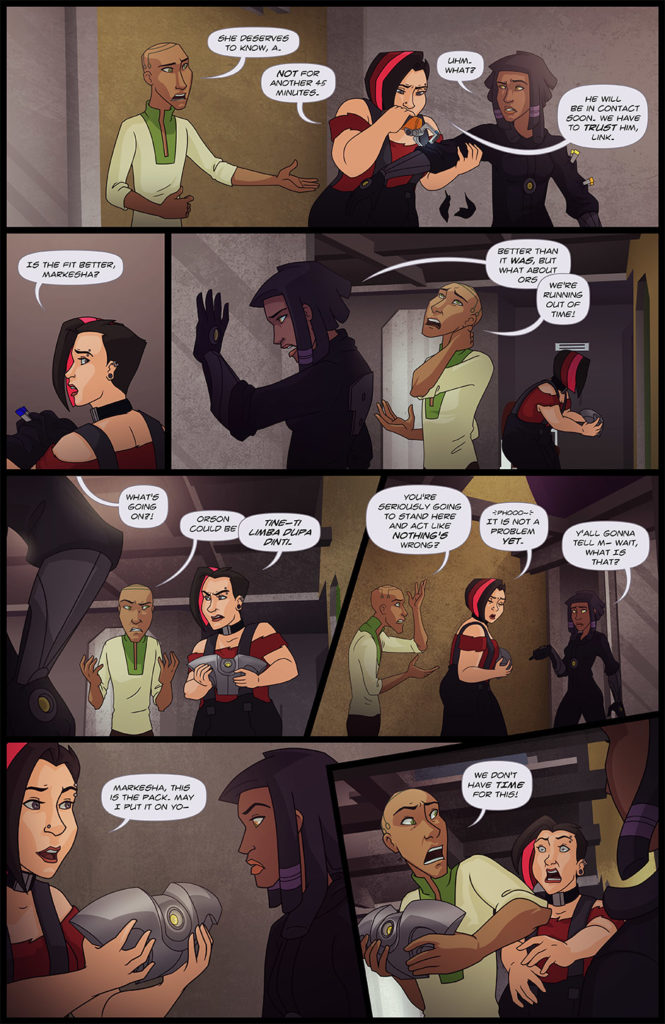
Pg. 13: Fitted for Trouble

Pg. 13: Fitted for Trouble published on No Comments on Pg. 13: Fitted for Trouble

Audrey flubs an apology to Markesha, but (thankfully?) Link interrupts by dropping a bombshell.

The suit that Markesha’s wearing is made of a material called Carbon Ampullate Silk (or C-Amp Silk for short). This fabric is unique in the source of it’s base materials for thread – carbon fiber, and artificial spider silk. C-Amp Silk is highly prized and extremely expensive due to the complex and long process of creating it’s unique fibers. The material is versatile in uses as it’s lightweight, stretchy, 98% waterproof and able to absorb energy. These properties make for a perfect battle uniform.

Unfortunately the last suit the team has on hand is flawed, and served as a testing ground for integrating Audrey’s tech into the suit. The artificial spider silk is a lower quality which made it easier to modify for testing, but less of a perfect candidate for Orson’s recruits. The last remaining suit is shrapnel resistant at best, but it’d be a stretch to call it bullet proof.

Pg. 12: Bad Timing, Bad Fit

Pg. 12: Bad Timing, Bad Fit published on No Comments on Pg. 12: Bad Timing, Bad Fit

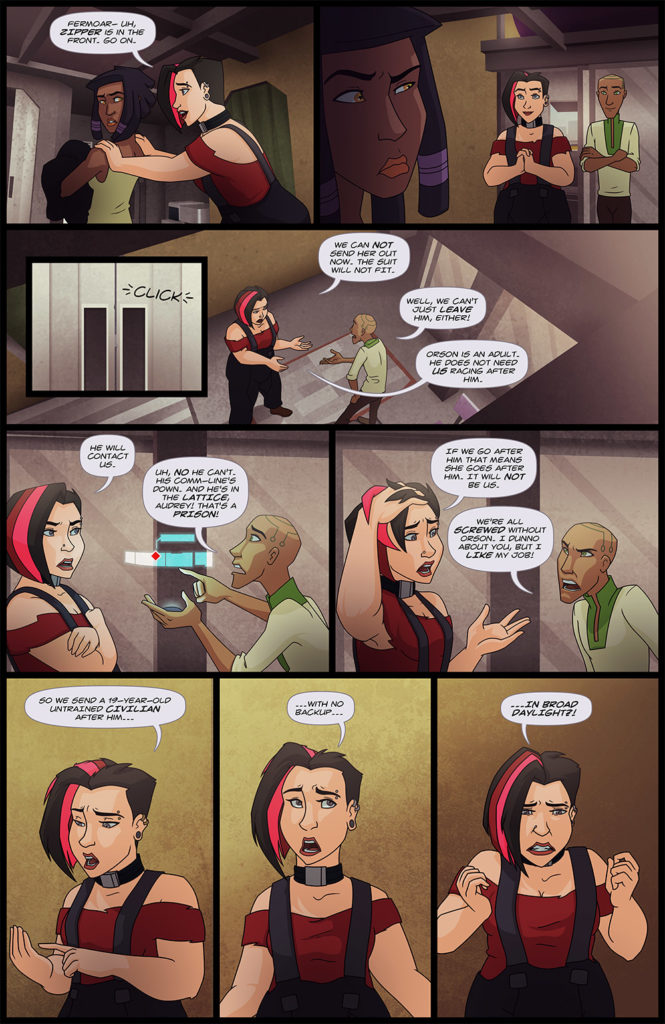
Orson’s window for contact is closing and his team is torn on what to do.


The panic code protocol Orson operates under has a two hour wait-time built in to prevent another form of panic making things worse.  Experience has taught him that giving the agent time to solve things themselves also prevents the support team from rushing headlong into danger unprepared. The way Orson sees it, two hours gives the support team time to adequately prepare for a rescue, or to fully determine that a rescue isn’t worth the effort.  The two hour wait has not been a popular part of the protocol with the team members under Orson’s command.

Pg. 11: Distract the Rookie

Pg. 11: Distract the Rookie published on No Comments on Pg. 11: Distract the Rookie

With Markesha distracted by the suit, Audrey and Link debate what to do about Orson.


When a panic code is initiated the comm-line for that person goes dark and the only thing left functioning is the tracer. To the novice intelligence agent this feature may seem counter-intuitive, however there’s a very good reason communication is severed. Let’s say that an agent is captured and their comm-line still functions. An at-risk agent takes a large risk communicating with their team on the comm-line. On one hand talking to oneself is an immediate give away and on the other hand, the instant an enemy realizes what’s going on the entire team is now at risk of exposure. In Orson’s mind it’s preferable to leave a captive agent in the dark than risk your entire operation. The less a captive knows about their potential extraction or total abandonment, the better.

Primary Sidebar